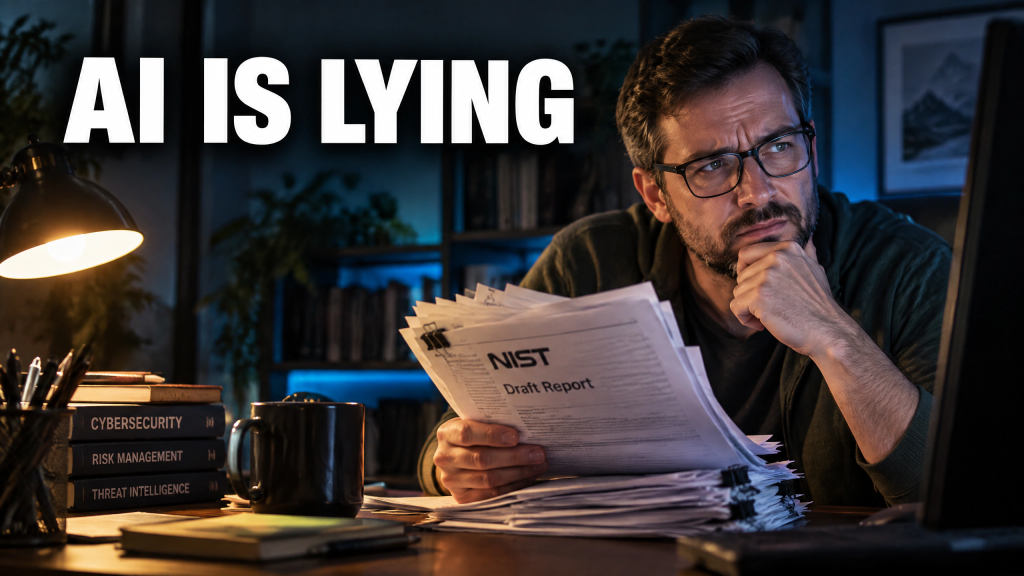
AI cybersecurity reporting is moving from experiment to everyday practice. On August 19, NIST released a draft guide showing how generative AI can help review security governance, organize evidence, and build Cybersecurity Framework 2.0 profiles. That can save hours. It can also produce a polished mistake faster than most teams can spot it.
NIST is showing what AI can do
NIST SP 1353 is an initial public draft. It includes structured prompts and three examples: reviewing policy and governance, drafting a current-state profile from documents and interviews, and developing a target-state profile from business needs and industry references.
The potential is practical. Security teams spend considerable time sorting notes, mapping controls, and rewriting technical material for different audiences. AI can take on much of that organizing and drafting work.
But NIST draws an important line. Its examples describe possible approaches, not prescriptive assessment or assurance methods. A generated profile is not, by itself, evidence that a control works or that an organization meets a requirement.
That distinction matters because AI reporting is only as good as the evidence behind it. The draft can get you moving. It cannot sign the report.
AI Needs Evidence to Lead the Process
A useful prompt starts with a well-defined task and reliable source material. The model needs to know which framework outcome it’s assessing, which evidence belongs to the organization, what period the review covers, and how to record uncertainty.
Give it vague notes, and it may fill the gaps with confident language. Give it contradictory files, and it may blend them into a smooth answer that never actually existed in the evidence.
That is where AI-assisted reporting becomes risky. The finished paragraph may look professional enough to discourage a second look, even when the reasoning underneath it is weak.
A reviewer needs to trace every material claim back to a policy, configuration, interview, test result, or other reliable source. When the evidence isn’t there, the report needs to say so.
And once the evidence has been established, another human judgment comes into play: how serious is the finding?
Risk still needs a human decision
AI can suggest a severity. It cannot take responsibility for the decision.
Risk depends on exposure, exploitability, existing controls, business impact, and the organization’s tolerance for loss or disruption. A model may miss that another tool enforces a setting. It may treat an automated alert as confirmation. It may even soften a serious finding because the supporting material was poorly written.
That is why the draft needs to be challenged, not just proofread. A qualified assessor can test the reasoning. Technical owners can confirm the facts. Leadership can weigh the business consequences before accepting the risk or funding the fix.
If the conclusion is wrong, “the AI wrote it” won’t satisfy a regulator, insurer, customer, or board. Another issue before any of that material reaches a model is who gets to see it.
Protect the material before asking for help
Cybersecurity assessments can contain some of an organization’s most sensitive information: system details, control gaps, employee interviews, incident history, and evidence of exploitable weaknesses.
That material doesn’t belong in an unapproved public AI service.
Use tools and accounts approved by the organization. Understand how prompts and uploaded files are stored, retained, and used. Remove unnecessary personal information. Restrict access. Keep track of the source material and the prompts used to produce important artifacts.
Those safeguards are part of the reporting process, not an administrative step added afterward.
They also become important once several people and systems begin working from the same assessment.
Keep one source of truth
Version drift can quietly undermine an otherwise careful report.
A technical team updates a finding, but the executive summary still carries the old severity. A standalone briefing differs from the version in the main report. Someone eventually has to ask which document the board should trust.
A single authoritative evidence package and final report version can prevent much of that confusion. Summaries can be generated from the approved source, and when a finding changes, dependent material can be updated and checked before delivery.
AI can help with that consistency check. A person still needs to approve the result.
Used carefully, AI can make cybersecurity reporting faster and clearer. Used carelessly, it can give weak reasoning a professional finish.
The boundary is simple: AI drafts. Humans verify. Leaders decide.
Cyber threats evolve rapidly—your team must stay prepared. Our penetration testing services provide hands-on training and real-world simulations to identify vulnerabilities before attackers do. As your trusted security partner, we craft assessments to your organization’s needs. Take a proactive approach. Schedule a consultation today at www.CybersecurityMadeEasy.com and safeguard your business.